Coverage Gaps
Coverage Gaps identifies common topics where Kapa was unable to provide a conclusive answer, helping you identify content and product gaps in your documentation. Coverage Gaps focuses specifically on uncertain answers to highlight areas where users are asking questions but Kapa cannot help them effectively.
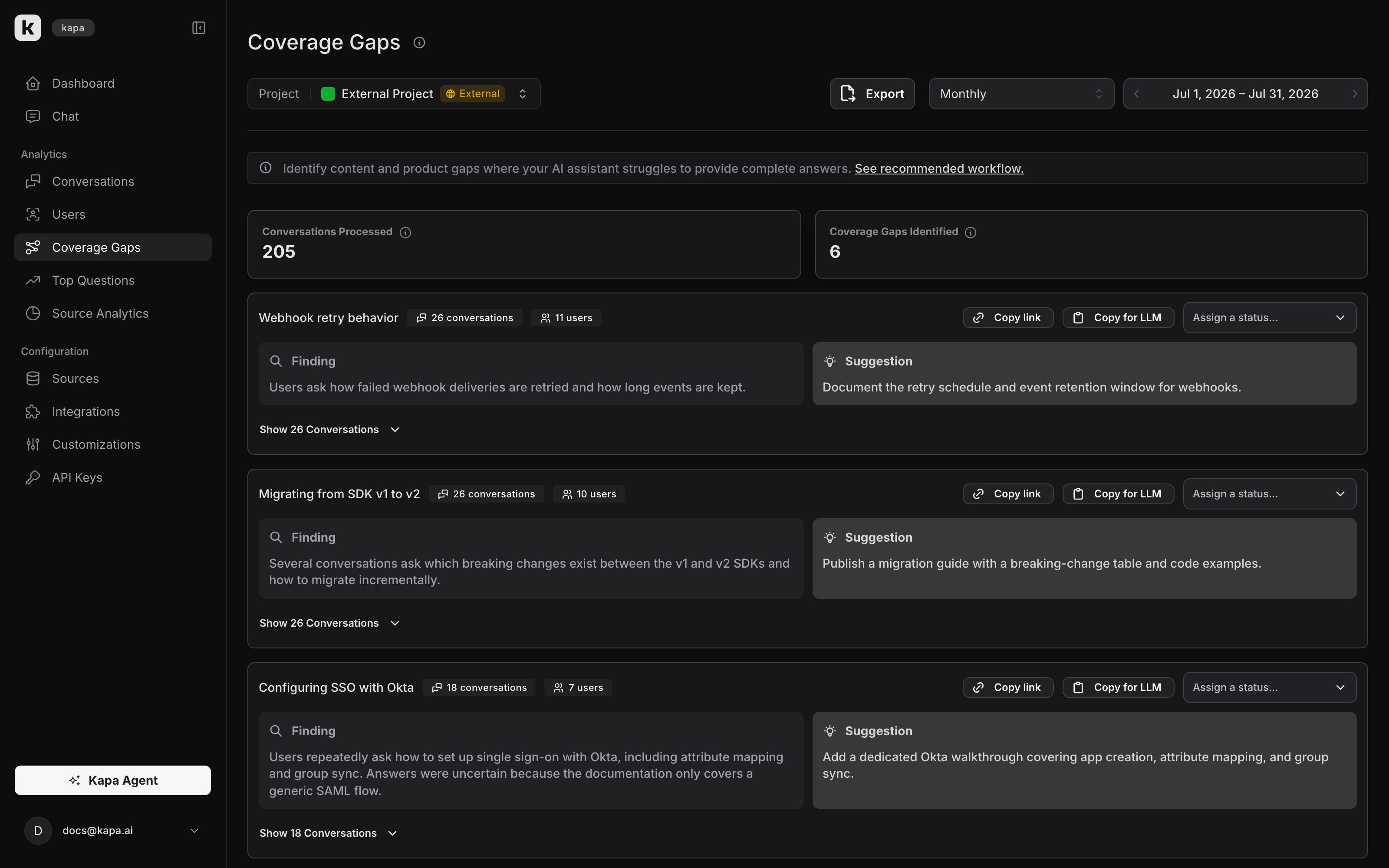
How coverage gaps work
For a selected time period (calendar week, month, or quarter), Kapa analyzes all Uncertain answers to determine common scenarios where Kapa failed to answer questions. When Kapa detects recurring topics that result in uncertain answers, it groups them into clusters and creates a summary with two parts:
- Finding: A breakdown of what users asked about and why Kapa failed to provide a complete answer
- Recommendation: AI-generated suggestions on how to address the identified gap by updating your documentation
The recommendations might suggest documenting an undocumented feature, marking a use case as unsupported, or identifying missing documentation entirely. These suggestions require human review to determine the actual problem and appropriate resolution.
Export
You can export Coverage Gaps data to a CSV file for further analysis. To export, click the Export button on the Coverage Gaps page. The exported CSV contains all clusters and their associated conversations for the selected time period.
Recommended workflow
The recommended way to act on your Coverage Gaps is the Improve documentation skill in the Kapa plugin. Run it with your coding agent from your documentation repository; there is no export to download.
The skill reads your Coverage Gaps together with uncertain and downvoted answers, Top Questions and Source Analytics, merges what concerns the same topic into one list, and checks each topic against your documentation. For each gap it recommends a change, or no change: some topics are intentionally undocumented, some are noise, and some are outside the scope of your documentation. You make the call and can fix the documentation on the spot. Decisions are recorded in your repository, so later runs do not raise the same topics again.
Coverage Gaps are computed per week, month and quarter. A project with a moderate number of uncertain answers may see clusters only in the quarterly view; the skill falls back to it and also reads recent uncertain answers directly.
See Improve your documentation with an AI agent.
FAQ
Why is the total count of processed conversations different from my total conversation count?
We include the first question in a conversation thread that is tagged as 'uncertain' and exclude the following:
- Threads not tagged as 'off-topic'
- Duplicate questions
What time horizons can I analyze?
Coverage Gaps are generated on a weekly, monthly, and quarterly basis. You can switch between time periods in the UI and navigate backwards and forwards to analyze how gaps change over time.
Why do I not see any clusters?
Your Kapa project needs a certain number of conversations with uncertain answers in a time period before Coverage Gaps can generate clusters. The exact number of questions depends on the questions your users ask.
How are Coverage Gaps different from the Top Questions feature?
Coverage Gaps focuses exclusively on uncertain answers to identify documentation gaps, while Top Questions analyzes all questions regardless of whether they are tagged 'uncertain' or not. This targeted approach helps you prioritize improving areas where Kapa cannot currently help users.